

Span 41 cm / 16.1 in
Weight 26 g / 0.9 oz
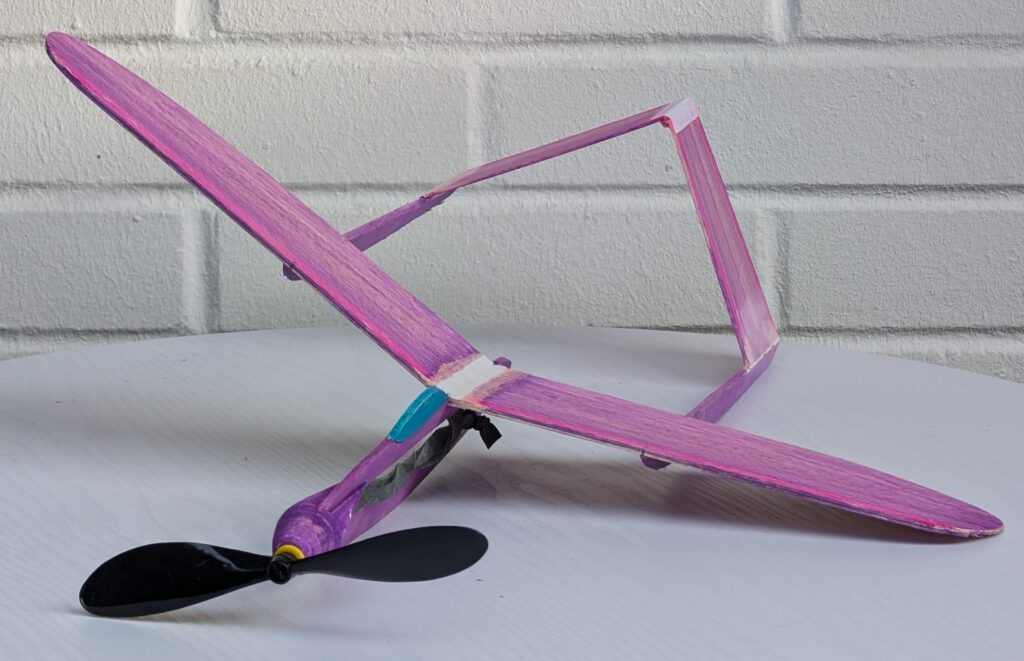


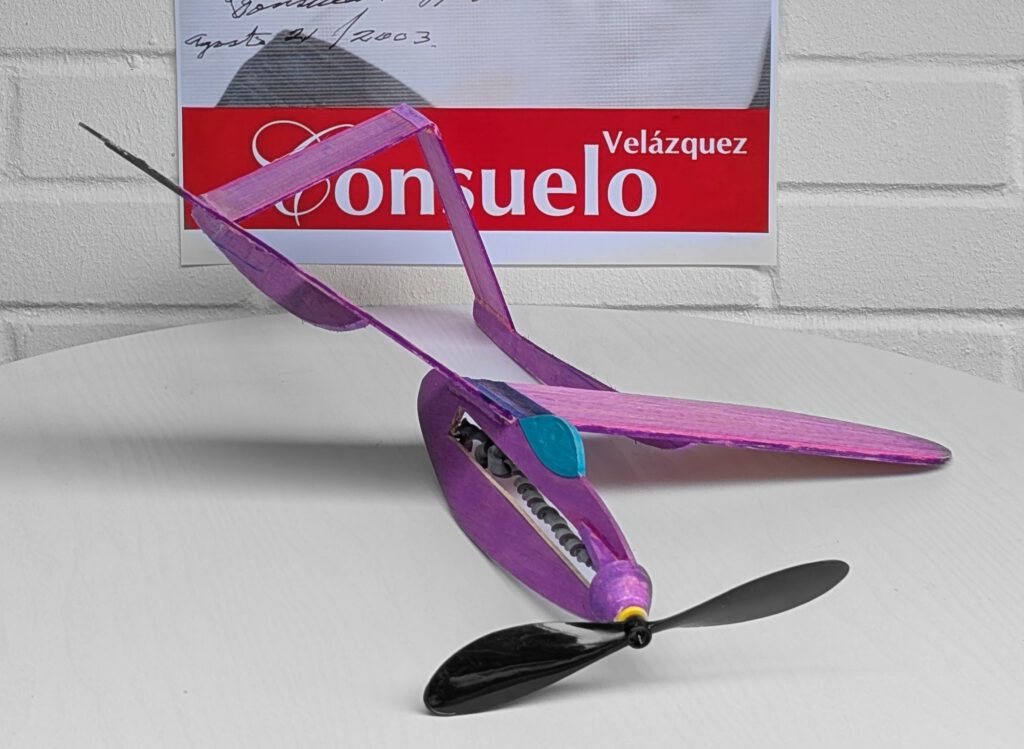


The concept:
- twinboom layout
- inverted vee-tail
- good flight characteristics
- light
- fast
- easy to build
- not too many parts
Name is Spanish of course. Means “You shouldn’t go (- do stay!)”
Building the rubber powered balsa profile-fuselage model Farmington Fairytale.
Materials:
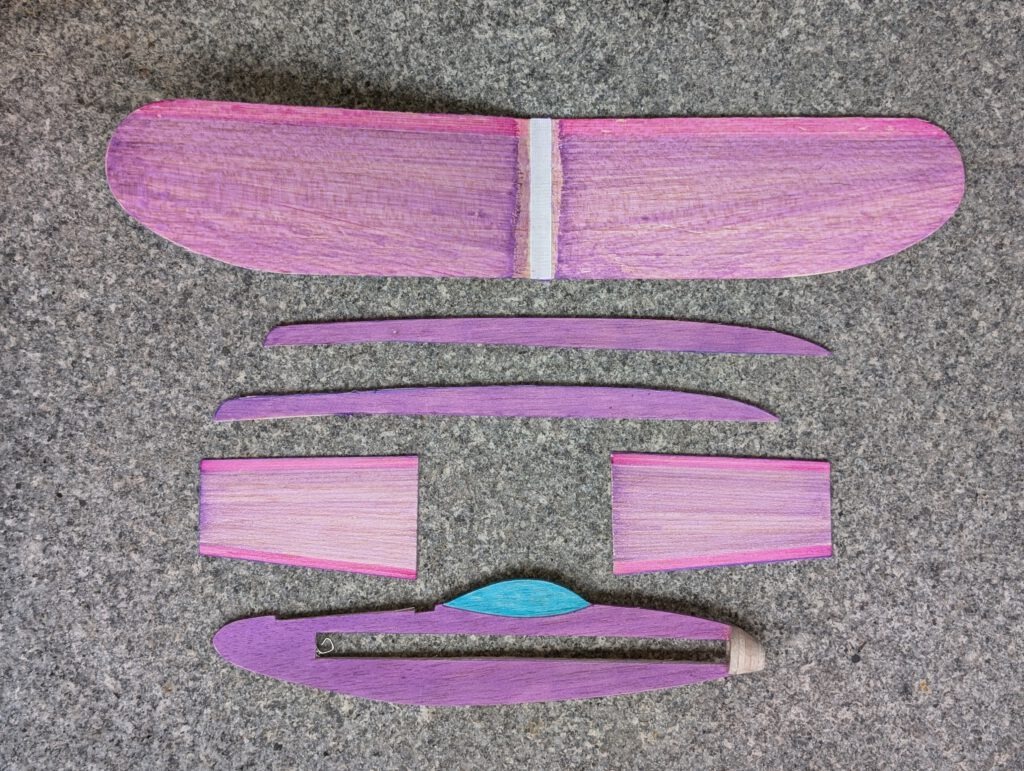
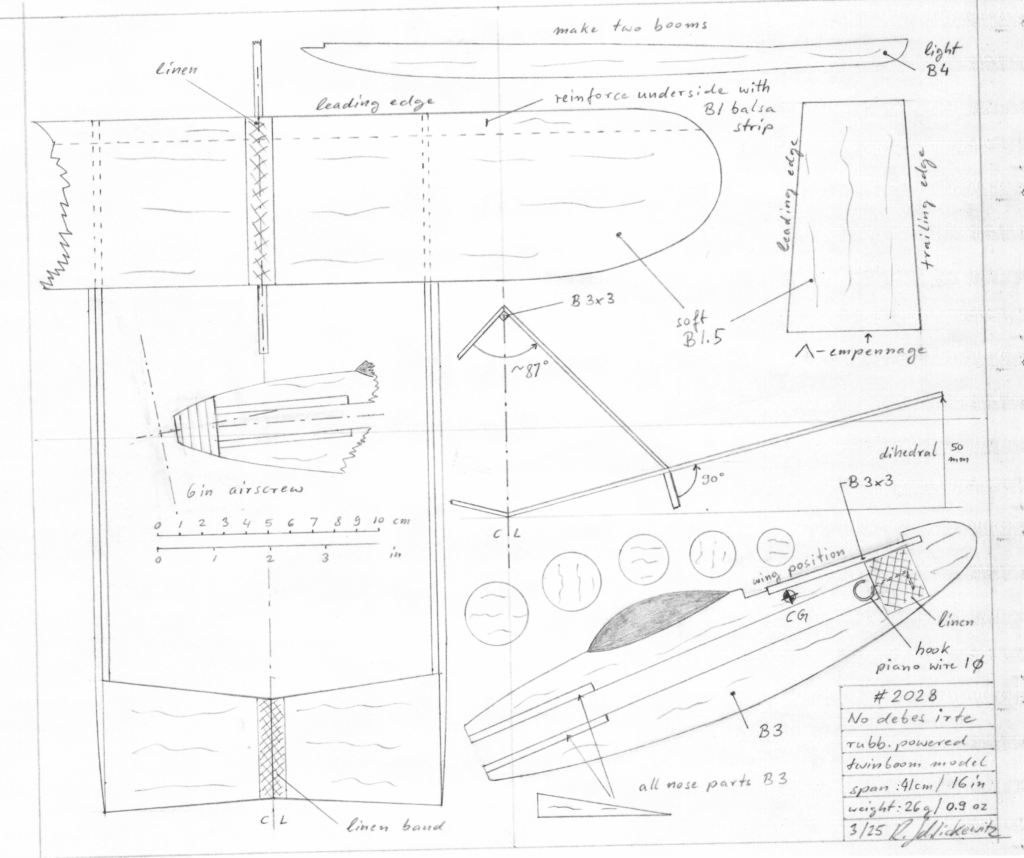
Fuselage gondola: B 3; all nose parts: B 3; rubber hook: piano wire 1.2 mm diameter; booms: soft B 4; wing: soft B 1.5; wing supports: B strips 3 x 3; vee-tail: soft B 1.5; vee-tail center strip: B 3 x 3; templates B 5; linen band width 1 – 1.2 cm / ½ in; ballast: small piece of lead or scrap metal; commercial airscrew 15 cm / 6 in diameter; black rubber.
Assembly:
Cut out all balsa parts. Sand well. Transfer outlines of cockpit etc. from paper to wood with pen. If coloring of your model is desired make it at this stage.
Fuselage-gondola:
Bend as shown on plan piano wire into given hook shape. Carve out with knife and round file seat for rubber hook on left or right side of fuselage gondola rear end. Cement hook in place and cover hook area with linen band as seen on photos. Let dry. Cement wing support strips in to their position on both sides of fuselage gondola, use for this needles or clamps to hold in place.
Cement B 3 nose cone parts one on the other as shown on plan and let dry. Sand well than treat this part with balsa putty. When dry sand again. May be this procedure has to be repeated. When the nose part is smooth you can start to carve out opening which holds prop-bearing. Start from behind and don’t do it in a hurry. A little electric drill machine can be useful.
Cement nose cone to fuselage according to photos. When dry add triangle shaped supports two on each side.
Wing:
Cement linen band along the whole leading edge of your still one piece wing. The band should embrace the leading edge in form of the letter U. Alternatively the wing’s leading edge can be reinforced by a B 1 Balsa strip on its underside as shown on plan. Work carefully and precisely as uniformity on the leading edge looks professional afterwards. When dry cut the wing at its center line. Fix one wing half with pins on your building board. Underlay tip of other wing according to given dihedral (5 + 5 cm) and join both halves. Cover joining areas with ample glue and linen band. Let dry.
Mark positions of fuselage gondola and booms on wing with pencil.
Vee-tail:
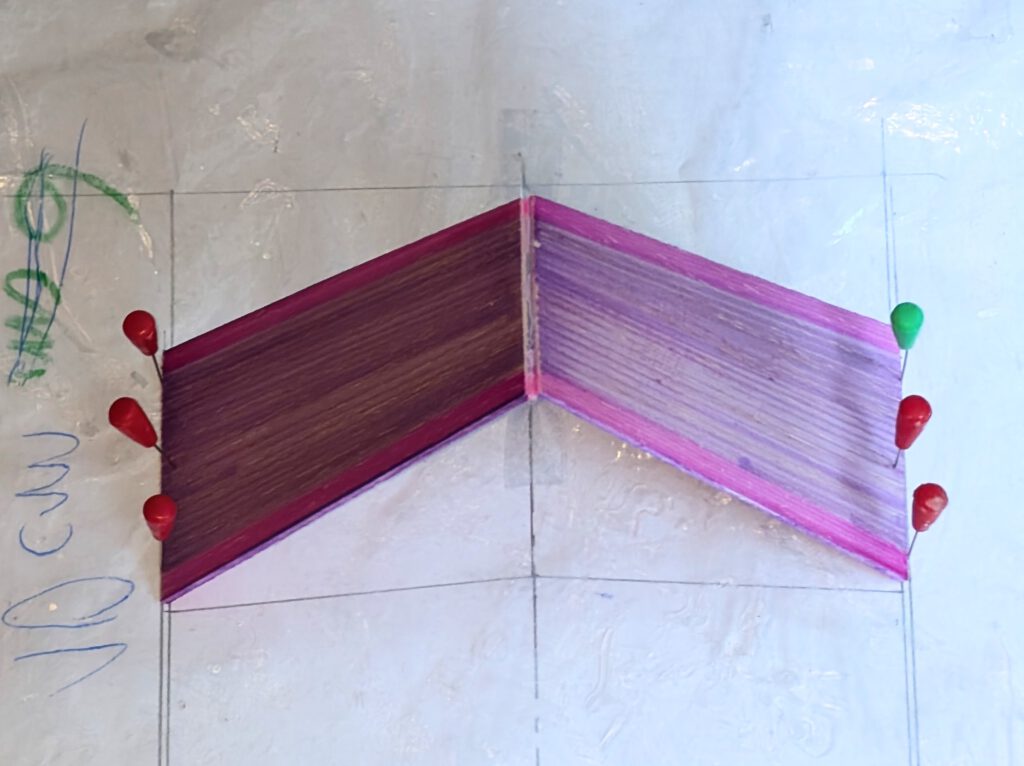
Make a template from B 5 which fits to the angle of both vee-tail parts as shown on plan. Join both vee-tail parts using the template and cover upper side with linen band. Check well symmetry. Cement Balsa strip (3 x 3) on underside as on plan. Vee-tail is now one part.
Final Assembly:
The next step requires great care. Turn wing upside down and pin it on a suited building board, one wing half hanging over the board’s edge. Cement one boom on wing at a 90 degree angle and corresponding to the markings you made at an earlier stage. Let dry.
Repeat this step for the other wing half and let dry.
Fix boom-wing-assembly on your building board with pins. Both booms must sit absolutely parallel and straight. Visual check from all sides. Cement then vee-tail on both booms. Check symmetry. Use needles to hold in place. Let dry.
Take two voluminous books or cardboard boxes or something comparable of identical size and place one next to the other at a distance of a half inch.
Remove wing-boom-empennage assembly from building board and cement it on the fuselage-gondola. Hold in place with pins and observe diligently symmetry. Now put the model on both books/boxes with its fuselage gondola hanging free between them. Let entirely dry.
Insert rubber-motor and airscrew. Balance your model in accordance to given CG on plan. Do your first unpowered test flights over tall grass.
Note that a correct C/G is essential for successful flights!
Observations: Model is fast. Fly over grass, preferably tall grass. If there is no grassland where you live, reinforce front fuselage with an extra plywood strip. Six-inch airscrew was best choice, no bigger prop needed.
Iyi uçuşlar! (Pleasant flights!)



Leave a Reply